

The 10,000 Dollar Chalk Mark: Pricing Work in the AI Era
Why clients should pay for the expertise behind the prompt, not just the output.
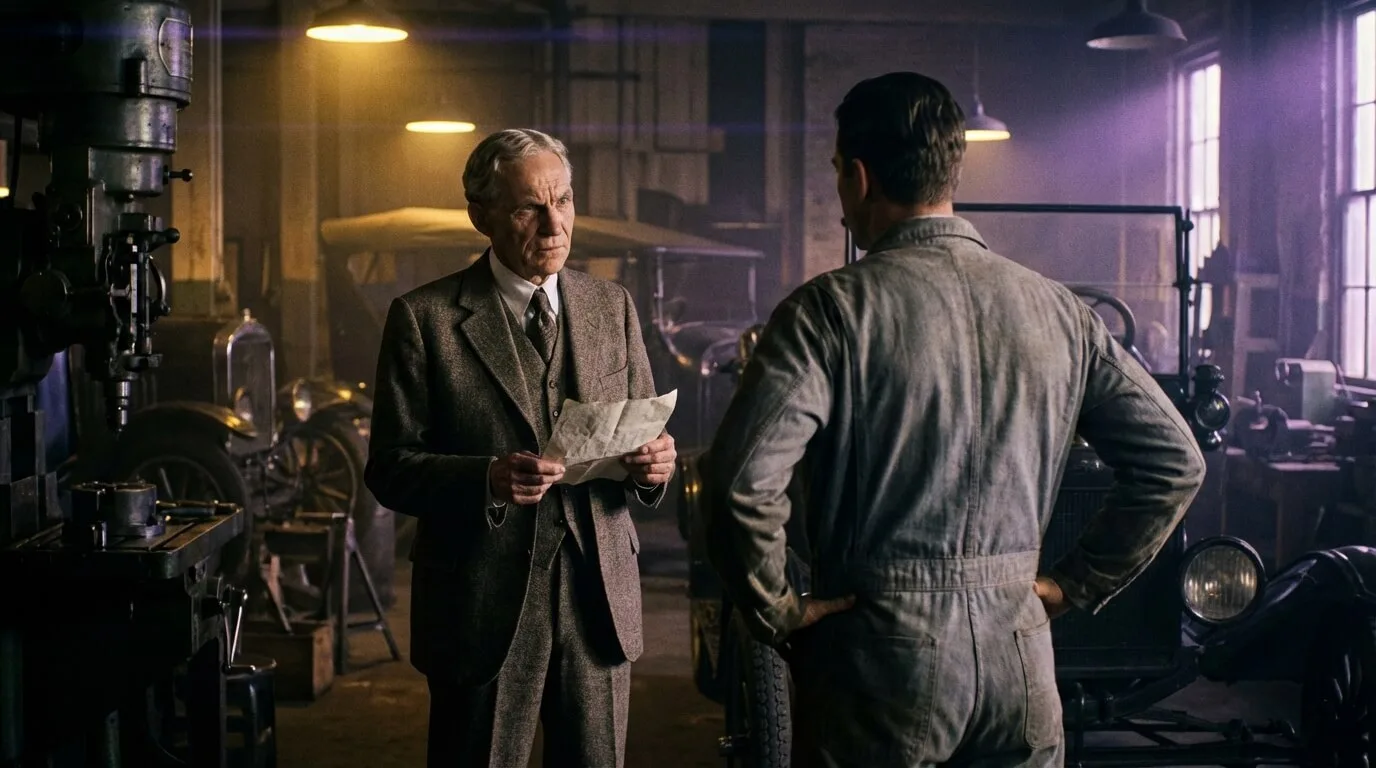
There is a famous story about Henry Ford and the engineering genius Charles Steinmetz that perfectly captures the tension between effort and expertise. In the 1920s, a massive generator at Ford’s River Rouge plant failed. The plant’s engineers were stumped. The downtime was costing a fortune. Ford finally called in Steinmetz.
Steinmetz arrived, asked for a notebook, a cot, and to be left alone. For two days and nights, he listened to the generator and scribbled calculations. On the second night, he asked for a ladder, climbed up, and made a single chalk mark on the side of the casing. He told Ford’s engineers to remove a plate at that exact spot and replace sixteen windings from the field coil. They did, and the generator roared back to life.
A few days later, Ford received a bill for $10,000. He was stunned by the price for what looked like a few minutes of work, so he asked for an itemized invoice. Steinmetz replied:
— Making chalk mark on generator: $1
— Knowing where to make mark: $9,999
I find myself thinking about this invoice constantly. We are living through a moment where the “chalk mark” has become virtually free. Artificial intelligence allows anyone to generate a blog post, a marketing plan, or a code snippet in seconds. Because the execution looks instant, clients often wonder why the strategic work behind it isn't equally cheap. They see the output and assume the process was just a button press.
The productivity paradox
It is easy to assume that because AI tools are accessible, the results are automatic. The reality is much messier. Recent data from Upwork revealed a startling statistic: 77% of employees say AI tools have actually increased their workload and decreased productivity. Instead of streamlining work, untrained users are drowning in a sea of generated content that requires endless editing, fact-checking, and refining.
This is what happens when you hand someone a piece of chalk but don't teach them engineering. They draw marks everywhere hoping one of them starts the engine.
The value we provide as an agency isn't in the generation of text or images. It is in the architectural understanding of how those pieces fit together to drive revenue. Anyone can ask ChatGPT to write an email sequence. Very few people know how to structure that sequence to warm up a lead, which psychological triggers to pull in the subject line, or how to feed the model the right context so it sounds like a human rather than a robot.
Millions of tokens later
When I tell a client that a project will take time and budget, even with AI, I am not trying to inflate the invoice. I am charging for the millions of tokens I have already burned through to figure out what actually works. Getting a Large Language Model to produce enterprise-grade output is not a matter of typing a sentence and hitting enter. It requires a deep understanding of prompt engineering, context windows, and iterative refinement.
We have spent thousands of hours testing different models against each other. We know when to use Claude for nuance and when to use GPT for logic. We know how to build data pipelines that prevent hallucinations. This is the modern equivalent of Steinmetz listening to the hum of the generator for two days. The final prompt might look simple, but it is the result of endless calculation and failure.
If you hire someone who charges you for the chalk mark, you get what you pay for. You get generic, flat, ineffective content that smells like AI and converts no one. You get the "busy work" that fills up a hard drive but doesn't move the needle.
Strategy is the new execution
The market is currently flooded with cheap execution. You can go to Fiverr and find someone to generate 50 SEO articles for pennies. But execution without strategy is just noise. The real scarcity in today's market is judgment.
My value proposition is that I don't pretend the work is magic, but I also don't pretend it's easy. We use AI to remove the drudgery, not the thinking. When we deliver a marketing strategy, we aren't charging you for the time the AI took to generate the draft. We are charging you for the years of marketing experience that allowed us to look at that draft, realize it was off-brand, adjust the parameters, feed it better data, and refine it until it was perfect.
McKinsey’s recent research backs this up. They found that while nearly 90% of organizations are using AI, only a fraction have successfully scaled it to produce real value. The difference isn't the tools they use. It is how they restructure their workflows around those tools. The high performers are the ones who treat AI as a force multiplier for human expertise, not a replacement for it.
Paying for the blueprint
We need to shift the conversation away from "how long did this take you?" to "what result did this produce?" If I can solve a problem in five minutes that used to take five weeks, the value to you is the solution, not the minutes. In fact, you are paying a premium specifically because I can solve it in five minutes. You are paying for the speed of the result, which was bought with the years of my own learning curve.
The next time you see an invoice and wonder why the cost seems high for something that involved AI, remember the generator. You can pay $1 for the chalk mark and hope you get lucky. Or you can pay for the expertise that ensures the engine actually turns on.
Keep reading
 Strategy
 The AI Hype Isn't Dying. It's Growing Up.
Something in AI is cooling off, but it's the froth, not the technology. The valuation gold rush is fading while real usage climbs, the same way the internet grew up. August 27, 2026 Strategy
 The Real Divide Isn't Human vs Machine. It's AI Fluency.
Everyone's debating humans versus AI. The real line is forming between people who are fluent with these tools and everyone else, and it's not a 10% gap. July 17, 2026 Strategy
 AI Isn't Killing Jobs. It's Shifting the Bottleneck.
The power loom automated 98% of a weaver's work, and weaving jobs grew. What the Industrial Revolution and my own AI work say about the future of your job. July 14, 2026